

CI/CDBy Ghaith METFAH
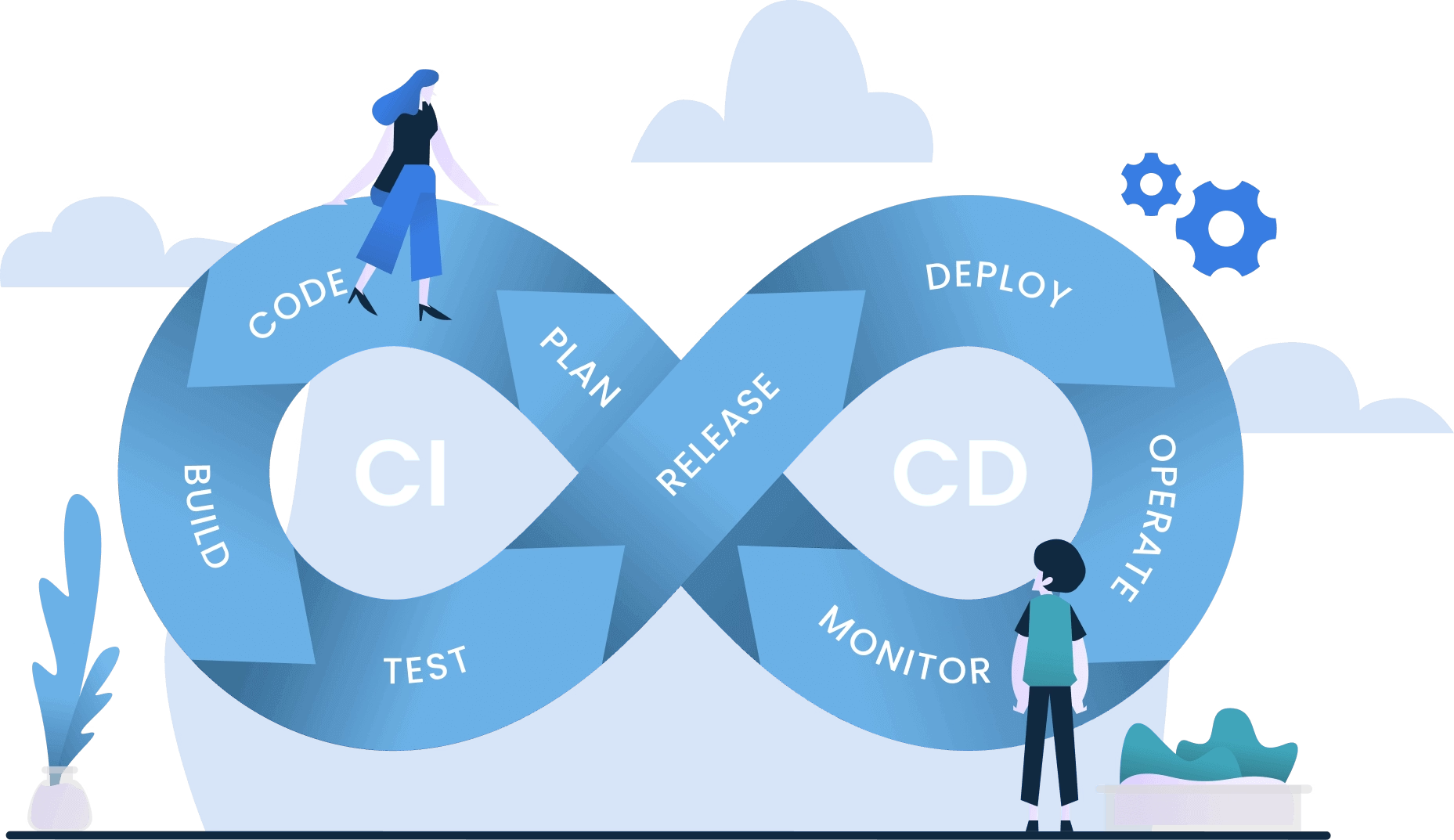
In the realm of DevOps, where speed meets stability, Continuous Integration and Continuous Deployment (CI/CD) is the heartbeat driving modern software delivery. Enabling teams to deploy code 208 times more frequently than traditional methods (per 2021 DORA), CI/CD automates the journey from commit to production—think a web app update hitting users in minutes, not months. Adopted by 92% of high-performing DevOps teams (per 2023 Puppet), it’s the backbone of agility at scale. This article dives deep into CI/CD, unpacking its workflows, tools, DevOps synergy, and the precision that powers rapid, reliable releases.
The Essence of CI/CD:
CI/CD fuses Continuous Integration (CI)—merging code frequently with automated testing—and Continuous Deployment (CD)—pushing validated builds to production seamlessly. CI catches bugs early: developers commit to Git 10x/day, triggering tests (e.g., 95% pass rate) to ensure a stable main branch. CD extends this: a passing build deploys instantly—Netflix rolls out 100s of updates daily, each in 5min. It’s DevOps’ promise—ship fast, fail small, recover quick. A 2022 GitLab survey found CI/CD cuts release cycles from 30 days to 2 hours, slashing time-to-market 90%.
Continuous Integration Mechanics:
CI starts with a commit—say, a React fix pushed to GitHub. A pipeline (e.g., Jenkins) triggers in 10s: linting (ESLint flags 5 errors), building (npm build, 30s), and testing (Jest runs 1K unit tests, 98% pass in 2min). Parallel jobs—4 cores cut test time 75%—run on ephemeral runners (e.g., GitHub Actions’ Ubuntu VMs). Failures (e.g., a 500 error) halt merges, notifying via Slack in 1s. Artifacts (e.g., a 20MB .tar.gz) store builds for CD. Etsy’s CI runs 10K tests/day, catching 85% of bugs pre-merge—it’s quality at velocity.
Continuous Deployment Workflows:
CD takes CI’s output and ships it. A pipeline stage (e.g., GitLab CD) deploys to staging—Docker containers spin up in 5s, integration tests (Selenium, 50 UI checks) pass in 3min. Green builds hit production: blue-green swaps v1.0 to v1.1 in 10s, 0% downtime, or canary releases (5% users) test in 1hr—rollback if errors spike 2%. Kubernetes applies manifests (e.g., 10 pods) in 15s, auto-scaling on 80% CPU. Spotify deploys 1K times/week with CD—95% succeed, 5% revert in 2min. It’s automation with a safety net.
Tools and Pipelines:
CI/CD thrives on tools. Jenkins, with 1M+ users, runs 100K builds/day—scripted in Groovy (e.g., pipeline { stages { build, test } }). GitHub Actions auto-triggers on push—10K workflows/month, free tier—while GitLab CI/CD integrates repo-to-deploy in 15 lines of .yml (e.g., deploy: image: docker). CircleCI parallelizes 50 jobs, cutting 10min to 2min. AWS CodePipeline ties to S3/EC2, deploying 1M apps/year. Tekton offers K8s-native pipelines—100 pods in 20s. From open-source to cloud, it’s a DevOps glue—commit to live in 5min.
DevOps Integration and Benefits:
CI/CD is DevOps’ core. CI aligns devs—10 commits/day vs. 1/week—merging a 100-person team’s code in 1hr, not 1month. CD syncs ops—automated deploys (e.g., 50 containers) hit K8s, monitored by Prometheus (99.9% uptime). Containers pair perfectly—Docker builds in CI (5s), CD rolls to prod (10s). Etsy’s 50 deploys/day or Slack’s 100K users/min rely on this—95% faster releases, 60x fewer failures (2021 DORA). A 2023 Datadog stat: CI/CD apps see 85% less downtime—it’s speed with stability.
Testing and Validation:
CI/CD lives or dies by tests. Unit tests (e.g., pytest, 2K checks) run in CI—95% pass in 1min—while integration tests (Postman, 100 API calls) hit staging in 5min. Load tests (Locust, 10K users) ensure 200ms latency at scale; a 2022 Netflix run peaked 1M streams, tweaking CD thresholds. Smoke tests (e.g., “homepage loads”) pass in 10s post-deploy, sanity checks (e.g., “login works”) in 20s. Flaky tests—5% fail randomly—use retries (3x) or quarantine. Airbnb’s 20K tests/day block 90% of bugs—it’s the gatekeeper.
Challenges and Best Practices:
CI/CD isn’t flawless. Pipeline sprawl—100 jobs/node—slows builds; parallelize (8x faster) or prune (50% leaner). Flaky tests waste 20% of runs—fix with timeouts (10s). Security lags—Snyk scans catch 95% CVEs pre-merge, but creds leaks (e.g., 2021 Codecov breach) demand secrets management (Vault). Best practices: test early (80% CI coverage), stage envs (dev → prod parity), rollback fast (canary 1min), and monitor (Grafana, 1s alerts). Cache builds—npm cuts 60s to 10s. It’s disciplined automation.
Conclusion:
CI/CD is DevOps’ turbocharger—208x faster deploys, 85% less downtime—merging code to prod with surgical precision. From Jenkins’ builds to K8s’ rollouts, it’s the pipeline tying dev to ops, containers to monitoring. With 92% adoption and tools scaling 1M apps, it’s not a process—it’s a revolution. As software races forward, CI/CD ensures velocity doesn’t sacrifice reliability, delivering a future where every commit counts.
Related Tags
- Automation
- Automatisation
- CI/CD
- Continuous Deployment
- Déploiement Continu
- DevOps
- Jenkins
