

Data EngineeringBy Sabri MAHMOUD
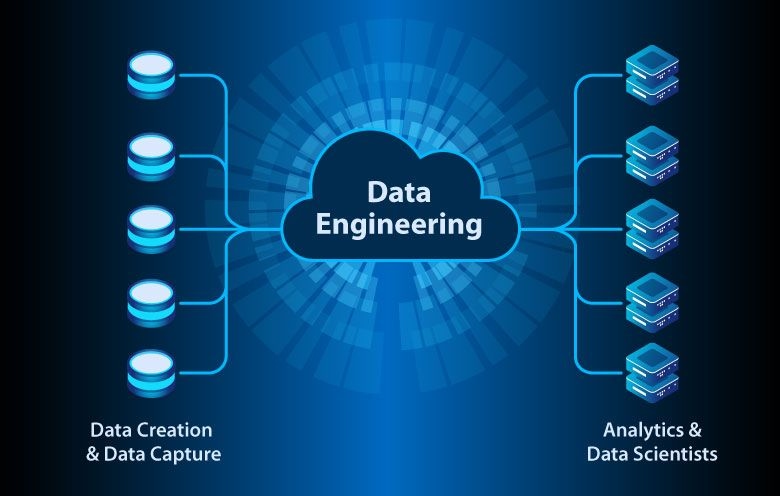
In a world awash with data—over 2.5 quintillion bytes generated daily—data engineering has emerged as the unsung hero of the digital age. It’s the discipline that transforms raw, chaotic data into structured, reliable systems, enabling everything from real-time analytics to machine learning models. While data scientists uncover insights and developers craft user-facing apps, data engineers lay the foundation, designing pipelines, storage solutions, and processing frameworks that power modern organizations. This article dives into the intricate world of data engineering, exploring its core principles, tools, and practices that fuel data-driven success.
The Essence of Data Engineering:
Data engineering is the art and science of building robust systems to collect, store, transform, and deliver data at scale. Unlike data science, which focuses on analysis, data engineering is about infrastructure—ensuring data is accessible, accurate, and timely. Picture a sprawling factory: raw materials (data) enter from sources like IoT devices, web apps, or APIs; data engineers design the conveyor belts (pipelines), warehouses (storage), and assembly lines (processing) to turn it into usable products. Companies like Netflix rely on data engineering to stream petabytes of viewing data daily, ensuring seamless recommendations and uptime. It’s a field where reliability trumps experimentation, and scalability is king.
Data Pipelines: The Lifelines of Data Flow:
At the heart of data engineering lie data pipelines—automated workflows that move data from source to destination, often transforming it along the way. These pipelines handle ETL processes (Extract, Transform, Load): extracting data from a CRM like Salesforce, transforming it by cleaning duplicates or normalizing formats, and loading it into a data warehouse like Snowflake. Tools like Apache Airflow orchestrate these workflows, scheduling tasks and retrying failures, while Apache NiFi offers visual pipeline design. For real-time needs, Apache Kafka streams data instantly—think Twitter processing millions of tweets per minute. A well-built pipeline cuts latency from hours to seconds, but a single bottleneck can grind analytics to a halt, making resilience critical.
Storage Solutions: Where Data Lives:
Data engineers architect storage systems to handle volume, variety, and velocity. Traditional relational databases (e.g., PostgreSQL) excel for structured data, but big data demands more. Hadoop HDFS distributes petabytes across clusters, tolerating hardware failures with triple replication. Cloud-native options like Amazon S3 offer infinite scalability—storing objects from logs to videos—while Google BigQuery marries storage with query speed for analytics. Data lakes (e.g., Delta Lake) unify raw and processed data, supporting diverse formats like JSON or Parquet. Choosing the right storage means balancing cost (S3 at $0.023/GB/month) with performance (BigQuery’s sub-second queries), ensuring data is both safe and ready when needed.
Data Processing: Turning Raw into Refined:
Raw data is useless without processing—data engineers wield frameworks to tame it. Apache Spark reigns for batch and streaming, crunching terabytes in memory with its RDDs (Resilient Distributed Datasets); a retailer might use it to aggregate daily sales across 10,000 stores in minutes. For real-time, Apache Flink processes event streams with exactly-once guarantees, powering fraud detection in banks. Batch jobs might run nightly on Hadoop MapReduce, though its disk-based approach lags behind Spark’s speed. Cloud services like AWS Glue automate ETL, while dbt (data build tool) transforms data in-warehouse with SQL. Processing isn’t just speed—it’s about accuracy, as a single misjoin can skew a million-dollar forecast.
Data Quality and Governance:
Garbage in, garbage out—data engineering demands quality control. Engineers implement validation checks (e.g., schema enforcement, null detection) and monitoring (e.g., Airflow sensors) to catch errors early. Governance ensures compliance with laws like GDPR, anonymizing PII (Personally Identifiable Information) or auditing access via Apache Ranger. Tools like Great Expectations test data integrity—ensuring a sales dataset doesn’t list negative prices—while metadata platforms like Apache Atlas track lineage, showing how data morphed from source to report. Poor quality costs: a 2021 Gartner study pegged bad data at $12.9 million annually for the average firm. Data engineers are the gatekeepers of trust.
Conclusion:
Data engineering is the bedrock of the data economy, turning a flood of bytes into a stream of value. From crafting pipelines that pulse with real-time data to architecting storage that scales effortlessly, data engineers enable the analytics and AI that define our future. With tools like Spark, Kafka, and S3, they tackle complexity head-on, ensuring data is not just big but usable. As organizations lean harder on data—projected to hit 181 zettabytes by 2025—data engineering’s role will only grow, demanding precision, creativity, and foresight to keep the digital world humming.
Related Tags
- Big Data
- Data Engineering
- Data Governance
- Data Pipelines
- ETL
- Gouvernance des Données
- Ingénierie des Données
- Pipelines de Données
